This site uses affiliate links to Amazon.com Books for which IANDS can earn an affiliate commission if you click on those links and make purchases through them.
1. Introduction to Edgar Cayce
Edgar Cayce (www.edgarcayce.org) had more out-of-body journeys than anyone ever documented. Cayce made over 14,000 journeys into the afterlife realms and was able to access virtually unlimited knowledge by visiting the so-called “Akashic Records” — a heavenly “Hall of Records” according to Cayce. Cayce described his subconscious mind (which he identified as his “soul“) would leave his physical body and explore the dimension where all subconscious minds are connected – a dimension similar in description to Carl Jung‘s collective unconscious. It is the realm of thought, imagination, dreams, and near-death afterlife realms where all things are possible. According to Cayce and the esoteric literature, these afterlife realms are known as the “astral planes.” Edgar Cayce described in four separate instances his out-of-body journeys. This article will list them.
2. Cayce’s Childhood Encounter With Death
In Harmon Bro‘s biography of Edgar Cayce, “A Seer Out of Season,” Harmon Bro writes of Cayce’s brush with death as a child and the psychic aftereffects that resulted from it:
“He told of how he had drowned and been pronounced dead in his youth and how the invisible playmates of his childhood had returned to him once as an adult” (Bro, 1989, p.426).
Cayce’s father, Leslie, also wrote about his son’s drowning incident giving more details:
“On one occasion after some very heavy rain had filled the ponds, lakes and lowlands to overflowing. Edgar decided to go fishing. He got his little fishing pole, hook, and line and started out perfectly alone.” The heavy rain had caused Edgar’s favorite pond to overflow onto a generally shallow area where some fish were now stranded. Edgar put down his pole and was happy wading out into the shallow water and just picking up fish with his hands and throwing them on the bank. However, in his enthusiasm Edgar ventured toward what was a deep hole some 10-12 feet deep. He slipped down the steep sides of the hole. Edgar had to stick his hands and feet in the muddy side of the hole to try to pull himself out. Luckily, a hired man on the farm came along with horses and a wagon of logs or rails. He saw the fishing pole, fish along of the road bank, and Edgar’s hat floating in the water, and he knew “that he [Edgar] was about to be drowned — or had been.” The hired man grabbed Edgar by the hand, pulled him out, and applied simple resuscitation skills that were generally known and brought the boy back to life. The hired man loaded Edgar on the wagon and took him back to his mother. Leslie then wrote that Edgar’s mother was frightened by hearing what had happened and “what he (Edgar) had seen.”
After Cayce’s NDE, all of his psychic gifts and abilities followed. He began reading the Bible, opened himself to God, and received psychic gifts such as precognition: the ability to look into the future and discern past events. These are normal aftereffects from having an NDE. He was able to see and talk to his late grandfather’s spirit, and often played with “imaginary friends” whom he said were spirits on the Other Side. He also displayed a supernatural ability to memorize the pages of books simply by sleeping on them.
At the age of twelve, Edgar asked for his own Bible and resolved to read the Bible straight-through once for every year of his life, even to the extent of catching up with the twelve years that had already passed. He stuck to his promise to the very end when he died at the age of sixty-seven. He had read the Bible sixty-seven times.
Moved by the Holy Spirit to declare himself a believer, Cayce was baptized by immersion at the age of thirteen. Shortly afterward, while Cayce was reading his Bible in a secluded spot near his home, a bright light filled the place where Cayce sat, and a figure all in white bright as the noon day light appeared. The figure said to Cayce:
“Your prayers have been heard. What would you ask of me, that I may give it to you.”
Cayce’s prayer was:
“…just that I may be helpful to others, especially to children who are ill, and that I may love my fellow man.”
Then the figure was gone.
Later in life, Cayce discovered that he had the ability to induce an out-of-body experience by lying down on a couch, closing his eyes, and folding his hands over his stomach and place his mind in contact with all time and space (the universal consciousness). From there, he could respond to questions as broad as:
“What is the meaning for the universe?” and “What is my mission in life?” to as specific as, “What can I do to help my headaches?” and “How were the pyramids of Egypt built?”
His reply to these questions became known as psychic “readings“. People today continue to consult these readings for advise.
References
(a) A Seer out of Season: The Life of Edgar Cayce – by Harmon Bro
(b) There Is a River: The Story of Edgar Cayce – by Thomas Sugrue
(c) Edgar Cayce’s Secret, Part 1 – by Eric Vandenbroeck
3. Cayce’s Afterlife Journeys – a Verbatim Account
The following is the only waking description of Cayce’s journey into the afterlife, taken verbatim from comments he made at a public lecture. Within his descriptions I have tagged corresponding NDE elements to the NDE:
“I see myself as a tiny dot out of my physical body, which lies inert before me.” [out-of-body] [orbs]
“I find myself oppressed by darkness and there is a feeling of terrific loneliness.” [the Void]
“Suddenly, I am conscious of a white beam of light, knowing that I must follow it or be lost.” [the Light]
“As I move along this path of light I gradually become conscious of various levels upon which there is movement.” [the tunnel] [various afterlife realms]
“Upon the first levels there are vague, horrible shapes, grotesque forms such as one sees in nightmares.” [astral realm]
“Passing on, there begins to appear on either side misshapen forms of human beings with some part of the body magnified.” [hell realms]
“Again there is change and I become conscious of gray-hooded forms moving downward. Gradually, these become lighter in color.” [heavenly realms] [spirit guides]
“Then the direction changes and these forms move upward and the color of the robes grows rapidly lighter.” [higher heavenly realms]
“Next, there begins to appear on either side vague outlines of houses, walls, trees, etc., but everything is motionless.” [I believe this realm is the physical realm which would appear outside of time.]
“As I pass on, there is more light and movement in what appear to be normal cities and towns. With the growth of movement I become conscious of sounds, at first indistinct rumblings, then music, laughter, and singing of birds. There is more and more light, the colors become very beautiful, and there is the sound of wonderful music. The houses are left behind; ahead there is only a blending of sound and color.” [cities of light] [heavenly music]
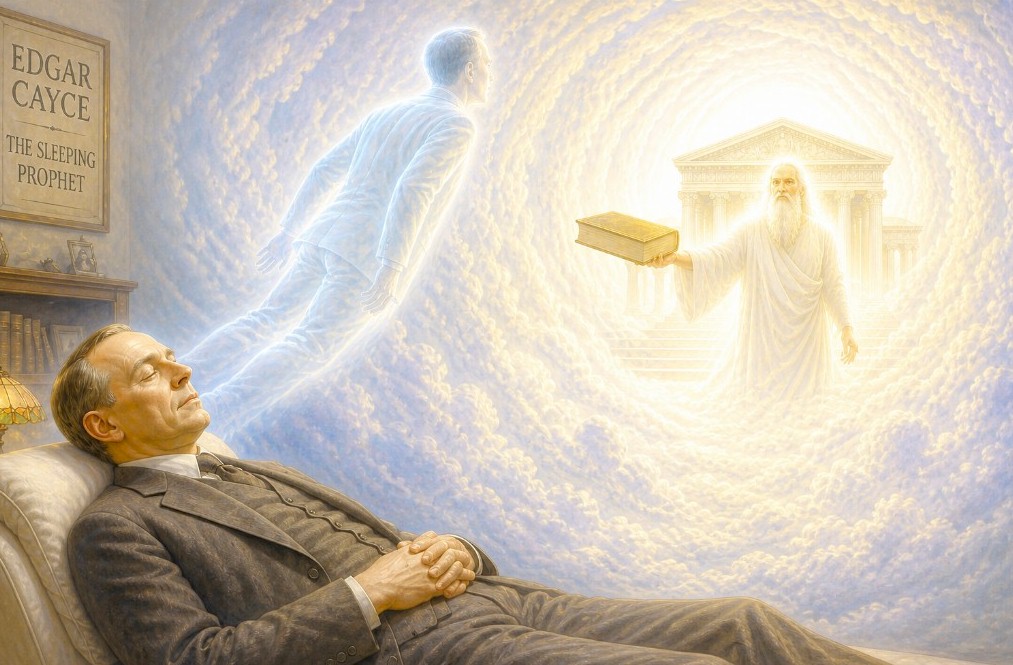
“Quite suddenly I come upon a Hall of Records. It is a hall without walls, without ceiling, but I am conscious of seeing an old man who hands me a large book, a record of the individual for whom I seek information.” [a good description of the Temple of Knowledge that people refer to in other NDEs]
4. Cayce’s Afterlife Journeys to the Hall of Records
According to Cayce scholar Henry Reed‘s book entitled Edgar Cayce on Channeling Your Higher Self which describes Cayce’s afterlife journeys, Cayce said he would feel himself to be like a bubble traveling through water to arrive at the place where he always got the information – the Hall of Records in heaven.
5. Cayce’s Afterlife Journeys Through the NDE Tunnel
Cayce scholar Henry Reed quotes from Cayce’s experience with the NDE tunnel:
 “…went up and up through a very large column, passing by all the horrible things without coming in contact personally with them, and came out where there was the house of records. Cayce stated that as he ascended the column, there would be beings on either side of him calling out to him for help or trying to get his attention. Cayce knew that any deviation from the column and the beam of light would mean he would not be able to return to his body. It, the column, wound around on a wheel like the Rotarians have.”
Cayce mentioned that he felt very secure traveling this way.
6. Cayce Meets the Angel of Death
While preparing to undergo one of his otherworldly journeys, Edgar Cayce had lost consciousness and had a dream. Usually, he would travel through a tunnel toward the light. But in this instance, he met the so-called “Angel of Death” and learned about the silver cord. The following is his experience described in his own words:
“As I went out, I realized that I had contacted Death, as a personality, as an individual or as a being. Realizing this, I remarked to Death: ‘You are not as ordinarily pictured – with a black mask or hood, or as a skeleton, or like Father Time with the sickle. Instead, you are fair, rose-cheeked, robust – and you have a pair of shears or scissors.” In fact, I had to look twice at the feet or limbs, or even at the body to see it take shape. He replied: ‘Yes, Death is not what many seem to think. It’s not the horrible thing which is often pictured. Just a change – just a visit. The shears or scissors are indeed the implements most representative of life and death to man. These indeed unite by dividing – and divide by uniting. The cord does not, as usually thought, extend from the center – but is broken from the head, the forehead – that soft portion we see pulsate in the infant. Hence we see old people, unbeknowing to themselves, gain strength from youth by kissing there; and youth gains wisdom by such kisses. Indeed the vibrations may be raised to such an extent as to rekindle or reconnect the cord, even as the Master did with the son of the widow of Nain. For he did not take him by the hand (which was bound to the body as was the custom of the day), but rather stroked him on the head – and the body took life of Life itself! So, you see, the silver cord may be broken – but the vibration …”
7. Cayce’s NDEs Analyzed by Kevin Williams
Edgar Cayce experienced clinical death as a child; but as an adult, he was able to travel through the dimensions of the near-death state by means of a self-induced out-of-body experience. This can be done by anyone, according to Cayce, if the proper attunement is made. Cayce also mentions that similar out-of-body journeys are done by everyone when they fall asleep and enter the realm of dreams, only it is done subconsciously not consciously.
Cayce’s experience reveals more aspects about the nature of the tunnel so often described in near-death experiences and more about the structure of the afterlife. One of the afterlife levels that Cayce observed while in the tunnel appears to be like our own except it is motionless. In my opinion, this motionless afterlife level is the physical realm – our physical universe. While Cayce journeys through the tunnel and the eternal now, time on Earth stands still. This principle can even be found in Einstein’s Special Theory of Relativity.
The afterlife level that Cayce saw where human beings appear with some body part magnified has been described in the Tibetan Book of the Dead and other religious traditions as being hell. It is a place where a particular desire has been overemphasized while in physical life. The level where hooded monk-like beings appear has also been described by many other near-death experiencers such as Dr. George Ritchie and Betty Eadie. Cayce was able to describe very accurately some of the various levels of the afterlife that appear in near-death accounts.
8. Did Edgar Cayce Have a Near-Death Experience?
By Neil Helm, M.A.
The following is an article entitled “Did Edgar Cayce Have a Near-Death Experience?” is from the Journal of Near-Death Studies, 32(4), Summer 2014 © 2014 IANDS reprinted by permission.
Edgar Cayce (1877–1945) is often called America’s greatest psychic, the Sleeping Prophet, a Seer. He also is often credited with being the father of holistic medicine for the many successful health remedies he prescribed while in a hypnotic trance (Bro, 1989; Kirkpatrick, 2000; Sugrue, 1945).
I began a formal study of NDEs in 2009. I chose this research subject to better understand my own NDE that I experienced in 1944 at age five. I didn’t tell anyone about my NDE until I was 31 years old, as I then discovered in 1975 that psychiatrist Raymond Moody had just published a book about NDEs entitled, Life After Life. After reading the book and finding people who were interested in NDEs, I began to do more investigating of NDEs and people who have had extraordinary spiritual experiences. Cayce’s name quickly appeared, and I read Thomas Sugrue’s (1945) book, There is a River, and other books on this incredible man, originally from Kentucky but having spent most of his adult life in Virginia Beach, VA. In reading about Cayce’s gifts, I found many similarities to myself and to other people who have had NDEs. These similar stories tell of the experiencer’s consciousness traveling to “the other side” and communicating with family members, spirit guides, and divinities. They also report experiencing NDE aftereffects like becoming more spiritual and developing paranormal abilities, such as being able to open the Book of all Knowledge, also known as the Akashic Record.
I started in early 2013 to investigate whether any evidence existed indicating Cayce had had an NDE. While reading the book, A Seer Out of Season (Bro, 1989), I found something! Harmon Bro, a graduate student, was working for Cayce in 1944. Cayce, who was in ill health, knew Bro was planning to write his Ph.D. dissertation on Cayce’s life and was providing Bro with some highlights from his earlier years to ensure they would be included in the work. Bro wrote of Cayce: “He told of how he had drowned and been pronounced dead in his youth and how the invisible playmates of his childhood had returned to him once as an adult” (1989, p. 426). Bro wrote down these discussions, and it is important to follow the flow of Cayce’s narrative – he drowned, and his invisible playmates came to him – implying the now well-known NDE aftereffect of seeing spiritual entities. I believe that Edgar drowned, had an NDE, and probably had his first out-of-body experience, an experience that he subsequently had more than 14,000 additional times. His apparently post-NDE invisible playmates, a visit from an angel, and the multitude of gifts that Cayce received from God, such as the ability to put himself in a trance and receive information from the Book of Knowledge, were, I believe, the results of his spiritual development provoked into accelerated advancement by his NDE.
Why did Edgar not speak more of this profound event in his life? First, the term “near-death experience” was not coined until Moody’s seminal 1975 book – published some 30 years after Cayce’s death. Second, although Cayce believed in past lives, traveling to the other side, and meeting Jesus, these subjects were not popular with many people in Christian circles during the first half of the 20th century. Even now, with nearly 40 years of research into NDEs, experiencers are sometimes reluctant to disclose their NDEs for fear of being dismissed, diagnosed, or demonized; this likely was even more the case at the time of Cayce’s life.
My continuing research into Cayce’s drowning led me to the big vault at the Edgar Cayce Association for Research and Enlightenment (ARE) in Virginia Beach where 14,306 of Cayce’s readings, along with some memorabilia and artifacts, are carefully stored. In the vault, I found some original notes by Cayce’s father, Leslie Cayce – often called the Squire.
Leslie Cayce related in his handwritten notes that his son Edgar was an outdoor boy who liked to hunt and fish. “On one occasion after some very heavy rain had filled the ponds, lakes and lowlands to overflowing, Edgar decided to go fishing. He got his little fishing pole, hook, and line and started out perfectly alone” (L. Cayce, n.d.). Although Leslie Cayce did not date these loosely written notes, he implied that little Edgar was quite young, I suspect around age five – similar to my age at the time of my own NDE. The heavy rain had caused Edgar’s favorite pond to overflow onto a generally shallow area where some small fish had become stranded. Edgar put down his pole and happily waded out into the shallow water in order to pick up the small fish with his hands and throw them onto the bank. However, in his enthusiasm, Edgar unintentionally ventured towards a sinkhole some 10–12 feet deep. He slipped down the steep sides of the hole. Edgar had to stick his hands and feet in the muddy side of the hole to try to pull himself out. Luckily, a hired man on the farm came along with horses and a wagon of logs or rails. He saw the fishing pole, fish along of the road bank, and Edgar’s hat floating in the water above the sink hole, and he knew “that he [Edgar] was about to be drowned – or had been” (L. Cayce, n.d.) – and rescued Edgar.
Some 30 years after the drowning, Leslie Cayce, writing for newspaper writers about this event, was trying to portray little Edgar as strong and resourceful, so he wrote that Edgar was coughing water and climbing out of the hole when the hired man grabbed his hand and pulled him out. I suspect that Edgar had, in fact, drowned; that the hired man pulled him out and applied simple resuscitation skills that were generally known at the time; and that he thus brought the boy back to life. In Cayce’s own words, he had told Harmon Bro that “he had drowned and been pronounced dead in his youth” (1989, p. 426). The hired man loaded Edgar on the wagon and took him back to his mother. Leslie then wrote that Edgar’s mother was frightened by hearing what had happened and “what he had seen.” I suggest that Edgar was telling his mother about his drowning and what he had seen during his NDE – contents of which, research has now revealed, sometimes upset those in whom NDErs confide.
After reading hundreds of NDE accounts, I am comfortable with the idea that Cayce’s remarkable life is the result of his meeting God, perhaps in the form of Jesus, during his NDE. After his experience, Edgar asked for his own Bible and opened himself to God. All of Cayce’s gifts and abilities followed. Apparently soon after his experience, Edgar was visited by his invisible friends. Later, an angel came to him in the garden. He could sleep on a book and acquire the knowledge within. Similar experiences have been related by children who have had NDEs. Cayce’s more dynamic gifts, such as putting himself in a hypnotic trance where he could acquire universal knowledge to look into past lives and future events (post- and precognition), are spectacular in their scope but, nonetheless, similar to psychic gifts other NDErs have received. Cayce understood this point and told Bro: “I don’t do anything you can’t do” (1989, p. 178).
Having an NDE seems to be a rapid way of traveling to the other side, meeting God, and acquiring special gifts. I believe Edgar Cayce’s life and work reflect this divine journey.
References
Bro, H. (1989). A seer out of season: The life of Edgar Cayce. New York, NY: St. Martin’s.
Cayce, L. (n.d.). Handwritten notes. Archives of Edgar Cayce’s Association for Research and Enlightenment, Virginia Beach, VA.
Kirkpatrick, S. (2000). Edgar Cayce, an American prophet. New York, NY: Penguin.
Moody, R. A., Jr. (1975). Life after life. Atlanta, GA.: Mockingbird Books.
Sugrue, T. (1945). There is a river: The story of Edgar Cayce. New York, NY: Dell.
9. Conclusion
The life and experiences of Edgar Cayce offer a compelling perspective on the transformative power of NDEs. His childhood brush with death appears to have marked a turning point – one that opened the door to a lifetime of profound spiritual insight, out-of-body journeys, and a deep connection to what he described as higher realms of consciousness.
What makes Cayce’s account especially significant is how closely it mirrors the patterns found in modern NDE research: the sense of leaving the body, traveling through darkness toward light, encountering otherworldly beings, and returning with lasting psychological and spiritual changes. These parallels suggest that his experiences were not isolated or purely symbolic, but part of a broader human phenomenon that continues to be reported across cultures and generations.
At the same time, Cayce’s ability to consciously access these states later in life raises important questions. If his initial NDE acted as a catalyst, it may point to the possibility that such experiences can expand human awareness in ways that are not yet fully understood. His descriptions of the “Hall of Records,” the structured afterlife realms, and the continuity of consciousness challenge conventional views of the mind as being confined to the brain.
Ultimately, whether one interprets Cayce’s experiences as spiritual, psychological, or a combination of both, they invite deeper reflection on the nature of consciousness and the boundary between life and death. His story offers a powerful reminder that moments at the edge of life can reshape a person’s entire understanding of reality, purpose, and the potential of the human mind.